
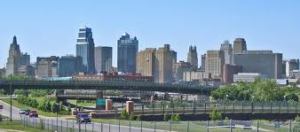
Image via Wikipedia
I’m going to Kansas City, Kansas City here I come! BBQ, Baseball and Jazz… I’m going to get me some!
This summer I drove down to KC with nine of my most immediate family. We loaded into two vans and headed south from the Twin Cities to Kansas City. On the hottest day of the year. Really! It was 102 degrees and one of the vans did not have a/c. Our mission: find the best KC barbeque and visit the birthplace of KC jazz and black baseball.
Before you read further I will admit to a few of things. I got the hives from the heat and had to stay in bed almost 48 hours. My mostly Muslim family went to Worlds of Fun/Oceans of Fun without me (still in bed) and were unindated by Christian music which was constantly (and loudly) broadcast throughout the amusement park. No worries about those carnies that love blasting Slow Ride here. And we did not find the best bbq in Kansas City. Despite that, we found some real gems in KC. This information is from my accumulated experiences though.
My husband, Rob, and I have been exploring KC for a few years. Every time we travel South to visit my family we go through KC (and Joplin but that’s an entirely different story). For a long time it was just a gas stop or an overnight cheap hotel on the way to Oklahoma (or that five hours we spent in a snow storm waiting it out at Chuckie Cheese). Finally we started making time for… you guessed it… food and music. That is what life is about, right?
One night we were driving through KC just about supper time. Rob had been trying to find a good steak house every time we passed through town without luck. We gave up on the steaks and decided to go for my favorite type of southern dinner – BBQ. I grew up in the south so BBQ often means really soft meat sans the spicy ketchup sauce. The meat is smoked, melts in your mouth and the taste can’t be hidden by any kind of sauce. So of course I was hoping to find that. My husband, having been born and raised in India, prefers as spicy as you can get. We always try to find a happy medium (and an extra bottle of hot sauce).
With my new cell phone and all its fancy apps I was able to track down the closest BBQ place we were passing by on the highway. Happened to be BB’s Lawnside Blues and BBQ. “B.B.’s Lawnside BBQ is Where BBQ Meets the Blues in Kansas City. For 20 years, B.B.’s has served slow-smoked meats (sausage, beef, chicken, pulled pork and ribs) from its 60+ year-old pit, Plus, B.B.’s menu includes signature Louisiana dishes like gumbo, jambalaya, red beans & rice and goulash. And, when you combine that with world-class blues entertainment, you get a unique Kansas City experience only found at B.B.’s Lawnside BBQ.” Yep, that’s right off their website but it certainly sums it up.

We drove a few miles through a deserted industrial area to get there, and yes, there is some kind of piece of grass next door to the parking lot. It’s a bit of a stretch to call it “lawnside,” but maybe in that area it passes. The inside is pretty much that scene from the Blues Brothers, where Jake and Elwood have to play in a honky tonk behind some chain link fencing and everyone throws empty beer bottles at them. Fortunately for us there were no crazy crowd or chain fences, nor flying beer bottles, just great food and amazing blues. There was a band of at least 10, including a hot horn section, and at one point two members of the band ran into the audience and did a great chest bump in the middle of a tune. Obviously a lot of energy and entertainment goes on at BB’s Lawnside. Great homestyle BBQ, long shared tables, awesome local brew and amazing music. And it was all very reasonably priced.

During our visits to KC we had learned about The Historic District of 18th and Vine. The district was the center for black culture and life in Kansas City from the late 1800s-1960s. Since the late 1990s it has been undergoing a revival. It was the hub of activity for homeowners, business, jazz music, and baseball enthusiast. Just outside of the district stands the Paseo YMCA building, which was built as a black YMCA in 1914. It served as temporary home for baseball players, railroad workers, and others making the transition to big city life in the Midwest. It was here that the Negro National League was founded in 1920. Although the district and the YMCA building were becoming blighted by the 1980s, they were recognized on the National Register of Historic Places.
During the late 1990s, plans were underway by city officials to create a new home to showcase Kansas City’s jazz heritage and to revitalize the Historic District. City officials and the mayor worked to raise over $20 million in bonds to build a new facility to host the new American Jazz Museum and a new, permanent and expanded, home for the Negro Leagues Baseball Museum. This new 50,000 square-foot building opened in September 1997 and the Baseball Museum opened in November.
Hot jazz, cool blues, historical and cultural preservation and good food. Just east of downtown KC. We took the kids to the baseball museum and the American Jazz Museum which showcases the sights and sounds of jazz through interactive exhibits and films, the Changing Gallery exhibit space, Horace M. Peterson III Visitors Center, Blue Room jazz club and Gem Theater. Kansas City is one of the greatest purveyors of jazz – and it continues to offer fertile ground for the music to thrive.
The kids were excited by the museums. The Jazz Museum, especially, is very interactive. Numerous kiosks use individual headphones to tell stories about the musicians, various types of jazz, and historical eras of jazz music. I could have spent a lot more time there as there was so much to absorb and learn. However, we were off to find food for a hungry crowd.

The original Arthur Bryants in the historic jazz district
Although Arthur Bryant’s was recommended by everyone in the neighborhood, I think it’s a taste acquired by growing up there. The BBQ sauce was vinegary with some lumpy dry spices in it. Have no doubt – the place was packed and there are tons of great reviews about the place (although there have been more unfavorable reviews of late – maybe they are focusing more on their product sales than their restaurant food?) It just wasn’t my type of barbeque. And everyone else in the family agreed. And the family includes some heavy duty BBQ connoisseurs. It is a well loved, neighborhood favorite, it just wasn’t what we were expecting. To order you must wait in line and order in a cafeteria style set-up. It was rather confusing but we ended up with burnt ends, turkey and fries.

Other places in the 18th and Vine area include Danny’s Big Easy, The Peachtree, the KC Blues & Jazz Juke House, and The Blue Room (part of the American Jazz Museum) which hosts Jazz Poetry Jams every 3rd Tuesday from 7 to 10pm. Other nights they offer up live music starting at 7 pm. The 2011 Rhythm and Ribs Jazz and Blues Festival is coming up on Oct 8.

The next night we tried Jack Stack’s BBQ near the river. The beef ribs were meaty and tender and the sauce was definitely a thick tomato and brown sugar base. The staff at the crowded restaurant was kind enough to set us in a huge booth area where we could all sit together (and not offend other diners with all of our noise and active kiddies).
There aren’t a lot of locally-owned accommodations in Kansas City – or at least we weren’t able to find them. There are a couple of B&Bs in nearby Bonner Springs. Airbnb lists a few places to stay: from a one bedroom rental in a private home for $40 a night to luxury Lofts downtown for $90 a night. With three adults and six kids under twelve we opted for a downtown hotel with two rooms and a pool. And we used that pool a lot since it was such a hot weekend. Unfortunately, a lot of b&bs don’t allow children.
Since we were downtown we were close to the restored Union Station (with lots of food, a permanent rail exhibit called the KC Rail Experience, exhibit spaces for traveling exhibits produced by the Smithsonian and other national organizations, a planetarium, an interactive science center called Science City and a vibrant Theater District featuring giant-screen movies and live theater, and much more.) and the Crowne Center which houses a Children’s Theater, the Hallmark Card headquarters (where kids can go to make crafts), a huge Crayola store also with fun activities, play areas (shooting water outside, an Amazon rainforest inside), and plenty of shops to buy any kind of KC BBQ sauce there is.
Also downtown, along the river, is the City Market. Since its inception in 1857, the City Market continues to be one of the largest and most enduring public farmers’ markets in the Midwest, linking growers and small businesses to the Kansas City community. This is where locals go! The City Market is one of the largest outdoor concert venues in Kansas City. There are a number of permanent vendors in the market, and more than 140 vendors on the weekends during the farmer’s market that burst with bedding plants, fruits, vegetables, herbs, fresh baked goods and other sweets, cut flowers and crafts made by local artisans.


We’re going to keep hunting for local places to stay. Please let me know if you have more local haunts to add to our KC stopovers!
44.944167
-93.086075







 Deborahmclaren's Weblog